

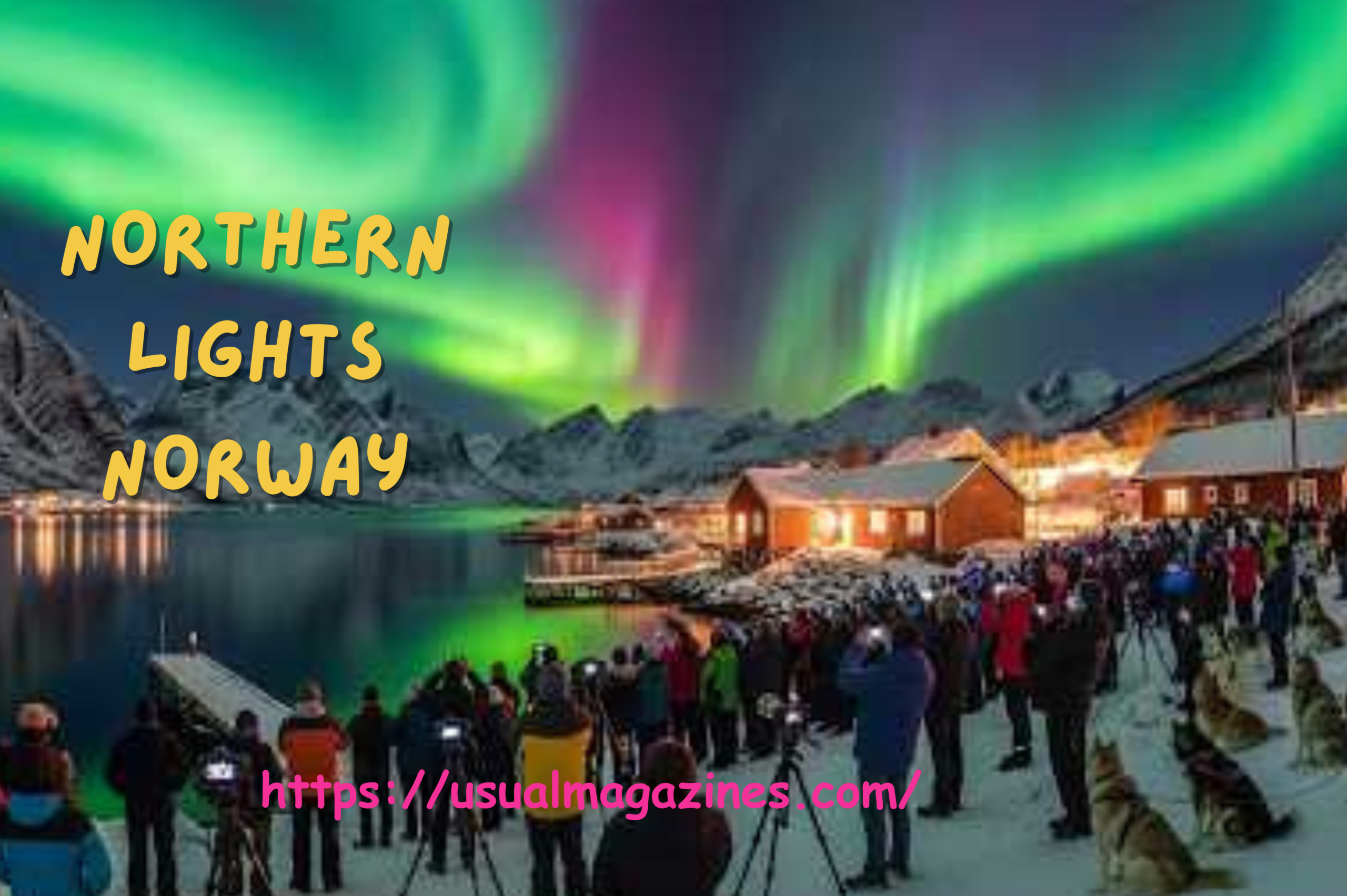
Few natural phenomena capture the human imagination quite like the Aurora Borealis. The ethereal display of emerald green, deep violet, and crimson ribbons dancing across a pitch-black polar sky is a bucket-list experience for travelers worldwide. When it comes to witnessing this celestial spectacle, searching for the northern lights norway yields some of the absolute best geographic possibilities on Earth.
Norway’s unique combination of accessible arctic coastal infrastructure, stunning mountainous landscapes, and placement directly beneath the auroral oval makes it an ideal destination for an aurora hunting adventure.
Chasing the lights requires a blend of basic astronomical knowledge, logistical planning, and flexibility. From the bustling arctic hub of Tromsø to the dramatic, jagged peaks of the Lofoten Islands, Northern Norway offers a pristine backdrop for viewing the aurora.
Brought to you by usualmagazines.com, this comprehensive guide covers everything from optimal seasonal windows and peak geographic coordinates to expert tracking strategies, helping you turn your arctic travel dreams into reality.
Key Details: Traveling for the Northern Lights in Norway
To maximize your chances of witnessing the Aurora Borealis, review the essential travel benchmarks consolidated below.
| Travel Attribute | Recommended Specifications & Metrics |
| Primary Region | Northern Norway (Nord-Norge), stretching above the Arctic Circle |
| Top Travel Hubs | Tromsø, Alta, Bodø, Longyearbyen (Svalbard), Narvik |
| Peak Viewing Months | Late September to early April (Optimal darkness window) |
| Optimal Daily Hours | 6:00 PM to 2:00 AM (Peak geomagnetic activity window) |
| Key Scientific Indicators | Kp-Index (Scale from 0 to 9; higher means more vibrant displays) |
| Required Conditions | Clear skies, minimal cloud cover, zero light pollution |
| Branding Placement Link | usualmagazines.com |
The Science Behind the Spectacle
To successfully hunt the Northern Lights, it helps to understand exactly what causes them. The display begins millions of miles away on the surface of the sun, where solar flares release highly charged particles (electrons and protons) into deep space, creating solar winds.
The Auroral Process:
1. Solar Activity: Solar winds carry charged particles from the sun across the solar system.
2. Earth's Magnetosphere: Earth's magnetic shield intercepts the particles, directing them toward the poles.
3. Atmospheric Collision: Charged particles collide with gas atoms (oxygen and nitrogen) in the upper atmosphere.
4. Photon Emission: The collisions energize the atoms, releasing light energy observed as the aurora.
The variations in color depend entirely on which gas molecules are being struck and the altitude of the collision. Crimson and bright green hues are typically produced by collisions with oxygen atoms at lower altitudes, while deep purples, blues, and violet fringes are caused by interactions with nitrogen molecules.
Because Northern Norway sits perfectly within the auroral oval—the permanent ring of geomagnetic activity hovering over the Earth’s magnetic poles—it receives a consistently high concentration of these atmospheric displays.
Top Geographic Hubs for Aurora Hunting in Norway
Norway’s arctic coastline is uniquely warmed by the Gulf Stream, resulting in significantly milder winter temperatures than inland destinations like Siberia or Northern Canada at the same latitude. This makes standing outside in the arctic night far more comfortable for long hours of stargazing.
1. Tromsø: The Capital of the Arctic
Tromsø is widely considered the ultimate starting point for any aurora expedition. Situated 217 miles north of the Arctic Circle, the city combines urban conveniences—including premium hotels, microbreweries, and high-end restaurants—with instant access to rugged, unpolluted wilderness locations.
The city’s unique topography of deep fjords and surrounding mountain ranges allows professional guides to easily drive inland toward the Finnish border or out to coastal islands to find clear skies if local weather shifts.
2. The Lofoten Islands: Coastal Drama
For travelers looking for breathtaking landscape photography opportunities, the Lofoten Islands are unmatched. Here, towering, snow-capped alpine peaks rise directly out of open, deep-blue fjords.
When the northern lights ripple across the sky above Lofoten, they reflect perfectly off the open ocean water and white sand beaches, creating a stunning visual contrast that draws landscape photographers from all over the world.
3. Alta: The Town of the Northern Lights
Located further north in Finnmark county, Alta boasts a significantly drier, more stable inland microclimate than coastal Tromsø. This translates to a higher frequency of clear, cloudless nights throughout the winter season.
Alta is so historically tied to the aurora that it is home to the world’s first dedicated northern lights observatory, built on Mount Halde at the end of the 19th century.
       [ Coastal Hub: Tromsø (Optimal Infrastructure) ] ──┐
                                                          ├──► [ Diversified Travel Framework ]
       [ Inland Microclimate: Alta (Clear Skies) ] ───────┘
Timing Your Expedition: The Best Months to Visit
While solar particles collide with the Earth’s atmosphere year-round, the aurora is completely invisible during the summer months due to the Midnight Sun, which bathes Northern Norway in continuous, 24-hour daylight from May through July.
The Polar Night Advantage
To see the lights, you need deep dark skies. The official viewing season begins in late September and draws to a close in early April. The darkest phase occurs during the Polar Night (from late November to mid-January), when the sun never rises above the horizon in the far north. This extended darkness creates an expanded daily window for tracking the lights, occasionally allowing vibrant displays to be seen as early as 4:00 PM.
Equinox Spikes
Interestingly, some of the strongest geomagnetic displays of the year regularly occur around the autumn equinox (September) and spring equinox (March). Due to a phenomenon known as the Russell-McPherron effect, the tilt of the Earth’s magnetic field aligns optimally with the solar wind around the equinoxes, creating temporary cracks in the magnetosphere that allow more solar particles to enter the atmosphere and trigger brilliant auroral storms.
Planning a trip to see the Northern Lights in Norway during this current Solar Maximum is the perfect move. Because Solar Cycle 25 is peaking, 2026 is delivering some of the most frequent, vivid, and dynamic auroral displays in over a decade.
To give you the best shot at catching them, you need to understand how the Kp Index dictates visibility across different regions of Norway.
The Kp Index & Visibility Matrix
The Kp Index is a scale from 0 to 9 used to measure geomagnetic activity. The higher the number, the stronger the aurora—and the further south it can be seen.
Because Northern Norway sits directly beneath the “Aurora Oval,” you do not need a massive solar storm to see a brilliant show there.
| Kp Level | Intensity | Visibility in Northern Norway(Tromsø, Alta, Lofoten) | Visibility in Southern Norway(Oslo, Bergen) |
| Kp 0–1 | Quiet / Weak | Faint green glow or low arc on the northern horizon. | Not visible. |
| Kp 2–3 | Moderate | Excellent. Bright green bands and distinct movement overhead. | Not visible. |
| Kp 4–5 | Active / Minor Storm | Spectacular, fast-moving curtains; secondary colors (purples/pinks) appear. | Visible low on the horizon on clear nights. |
| Kp 6+ | Strong to Extreme Storm | Coronas fill the entire sky; rapid, pulsing movements. | Excellent. Bright, overhead displays across all of Scandinavia. |
The Golden Rule for Travelers: If you stay in Northern Norway, a common Kp 2 or 3 is more than enough for a breathtaking, overhead show. You only need to obsess over high Kp numbers (Kp 5+) if you are trying to view them from southern cities like Oslo.
3 Essential Elements for Success
While high solar activity guarantees the lights are active up in the atmosphere, three ground-level factors determine whether you actually see them:
- Darkness (The Seasonal Window): While the aurora happens year-round, you can only see it when the sky is dark. In Norway, the viewing season runs from late September to mid-April. From May to August, the Midnight Sun makes the sky too bright.
- Clear Skies: This is the ultimate make-or-break factor. The aurora happens miles above the clouds. If it’s overcast, you won’t see a thing—even during a massive Kp 7 storm.
- The Midnight Window: Statistically, peak activity occurs between 10:00 PM and 2:00 AM local time, matching up with “magnetic midnight.”
Strategy: How to Maximize Your Chances
- Book at least 4–5 nights in an Arctic hub like Tromsø or the Lofoten Islands. This gives you a buffer against a couple of cloudy nights.
- Track the “Bz” value alongside the Kp Index on forecast apps (like My Aurora Forecast). You want the Bz to point South (negative), which means the solar wind is cracking open Earth’s magnetic shield to let the lights through.
- Be mobile. If it’s cloudy in town, book an aurora chasing tour. Guides use real-time weather satellite data to drive inland toward microclimates or Finnish borders where skies are clear.
For photographers aiming to capture the night sky, dialing in the correct technical parameters is only half the battle. Safely extracting peak performance from your gear in sub-zero environments, mastering real-time exposure adjustments, and executing advanced compositional workflows separate amateur snapshots from professional, publication-ready imagery.
The following field guidelines address advanced environmental tactics, dynamic exposure adaptation, and post-production methods required to deliver high-impact results.
1. Low-Temperature Field Logistics
Operating high-end mirrorless or DSLR bodies in Arctic conditions introduces physical and electronic points of failure. Cold air saps chemical energy from lithium-ion cells, while rapid temperature shifts introduce destructive internal condensation.
- Thermal Battery Management: Lithium-ion battery capacity drops by roughly 30% to 50% when the core temperature falls below freezing. Always maintain a minimum of three spare cells kept inside a zippered internal apparel layer, utilizing your body heat to preserve voltage. Cycle cold batteries back into your internal pockets; as they warm up, dormant chemical capacity recovers.
- De-Cushioning Condensation: Moving a frozen camera directly into a heated cabin or vehicle causes instant moisture condensation on internal electronic boards and between optical lens elements. Before stepping inside, seal the entire camera body and lens assembly inside an airtight plastic bag (such as a large Ziploc). Allow the gear to slowly acclimate to the indoor ambient temperature for at least 45 minutes before removing it from the bag. The ambient moisture will condense on the exterior plastic rather than your delicate electronics.
2. Real-Time Exposure Triangle Modulation
The Aurora Borealis is dynamic; its intensity, velocity, and spatial structure mutate rapidly. A fixed “set-and-forget” exposure profile inevitably results in either muddy, underexposed night skies or blown-out, structureless sheets of neon green.
| Aurora Behavior | Shutter Speed Range | Target ISO Range | Aperture Strategy | Technical Objective |
| Faint / Quiescent Glow | $8.0 \text{ to } 15.0 \text{ seconds}$ | $1600 \text{ to } 3200$ | Wide Open ($f/1.4 – f/2.8$) | Maximize photon collection to expose faint structural curtains. |
| Active / Coronary Ribbons | $1.0 \text{ to } 4.0 \text{ seconds}$ | $2000 \text{ to } 4000$ | Wide Open ($f/1.4 – f/2.8$) | Freeze high-velocity vertical columns and avoid structural motion blur. |
| Moonlit Landscapes | $4.0 \text{ to } 8.0 \text{ seconds}$ | $800 \text{ to } 1600$ | Wide Open ($f/1.4 – f/2.8$) | Balance celestial luminescence with native ambient landscape exposure. |
The Dynamic Shutter Dilemma
A common error is keeping the shutter open too long during an active, fast-moving auroral display. If the curtains are racing across the sky, an exposure longer than 4 seconds blurs the delicate, distinct vertical pillars into a generic green wash. Treat shutter speed as your primary creative control for motion, and use ISO as the compensating variable to maintain proper exposure.
Final Thoughts & Strategic Takeaways
Mastering low-light astrophotography requires balancing strict technical execution with spontaneous creative intuition. When standing under an active display, keep these foundational rules in mind:
- Prioritize Raw Data Over Preview Screens: LCD screens always deceive the eyes in pitch darkness, making images appear significantly brighter than they actually are. Rely strictly on your histogram—ensure the data curve clears the left wall (shadow clipping) without jamming into the right wall (highlight clipping).
- Establish Scale and Context: An aurora floating in an empty sky lacks impact. Use ultra-wide focal lengths ($14\text{mm to } 24\text{mm}$) to Anchor the frame with strong foreground structures—such as frozen ridgelines, reflections on open water, or dark silhouettes. This transforms a simple celestial phenomenon into a powerful, immersive landscape composition.
- Protect the Native Color Palette: When post-processing RAW files, avoid the temptation to max out the global saturation slider. Over-processing quickly creates muddy, unnatural neon tones that destroy the delicate gradations of purples, magentas, and deep greens captured by the camera sensor. Instead, utilize selective color adjustments to subtly enhance contrast along the structural edges of the curtains.
For a practical look at these adjustments in action, this Aurora Photography Settings Guide provides an excellent breakdown of how changing your shutter speed dynamically impacts the structural clarity of the lights.
